
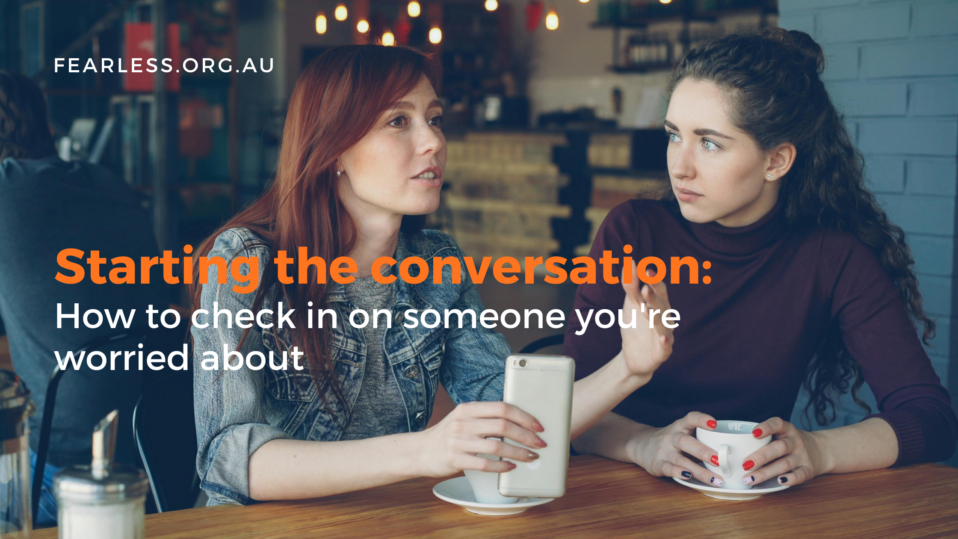
Talking about mental health can feel like a big thing. Many of us hold back because we’re worried about saying the wrong thing, making it worse, or simply not knowing how to help. Yet checking in on someone you care about rarely needs the right words or any special training. Often, noticing a person and letting them know you’re there is what matters most.
It can take a little courage to ask someone how they’re really going. The reassuring part is that you don’t have to fix anything. Sometimes the most powerful thing you can offer is to listen.
Why starting the conversation matters
When someone is struggling, a genuine check-in can be the moment things start to shift. It tells them they’ve been seen, and that support is within reach. This is the whole idea behind R U OK? Day, and it holds just as true on any ordinary day of the year.
The people around someone living with post-traumatic stress play a real part in how they cope and recover, something we look at more closely in our guide to supporting someone with post-traumatic stress.
How to start the conversation
The first step is often the hardest, and it doesn’t need to be complicated. Look for a moment that feels natural, like a walk, a coffee, a drive, or a message saying you’ve been thinking of them. Gently mention what you’ve noticed, in a caring way. You might say, “You’ve seemed a bit flat lately, how are you really going?” Coming from a place of care rather than pressure keeps the conversation relaxed. If that first chat only scratches the surface, that’s okay. You’ve opened the door.
The Australian charity R U OK? offers four simple steps for these moments: ask, listen with an open mind, encourage action, and check in. Their how to ask guide is a helpful place to start.
How to listen when someone opens up
When someone does begin to share, listening is the most valuable thing you can give. The instinct is often to jump in with advice or try to solve the problem, when most people simply need to feel heard. Let them talk without interrupting or rushing them. A few honest words can go a long way, like “That sounds really hard” or “I’m really glad you told me.” Acknowledging how they feel helps them know their experience matters.
One thing worth avoiding is finishing with “let me know what I can do.” However kindly meant, it quietly hands responsibility back to the person who is already struggling. Offering something specific instead, like a walk on the weekend or a call later in the week, takes that weight off them.
What if talking isn’t enough
If you’re genuinely worried that a conversation isn’t enough, you can gently ask whether they’ve thought about talking to someone else as well, perhaps a GP, a counsellor, or another person they trust. Try not to push this too fast. For many people the first conversation is the important step, and the rest can follow in its own time. Our overview of what post-traumatic stress is may also help you understand what someone could be going through.
Follow up afterwards
A few days later, a short message can mean a great deal. Something as simple as “I’ve been thinking about you, how are things today?” shows the person that the conversation stayed with you, that you heard them, and that you’re still around. Checking in again is often where trust is built.
None of us can solve everything for someone else. But we can show up, we can listen, and we can remind people they don’t have to face things on their own. Sometimes the most important thing you can say is simply, “I’m here.”
Where to find support
If you or someone you care about needs to talk, support is available.
- R U OK? has a practical how to ask guide at ruok.org.au/how-to-ask.
- Lifeline: 13 11 14, 24-hour crisis support (Australia).
- Beyond Blue: 1300 22 4636, support for anxiety, depression and low mood (Australia).
- Need to Talk?: free call or text 1737, any time (New Zealand).
If someone is in immediate danger, please call 000 in Australia or 111 in New Zealand.
FearLess and community
FearLess is a charity supporting people living with post-traumatic stress and their families across Australia and New Zealand. Connection is at the heart of what we do, and a single caring conversation can be the start of someone feeling less alone.
If you believe everyone affected by post-traumatic stress deserves better access to information, community and care, you can support our work or read more on the FearLess blog.
This article is for general awareness only. FearLess is not a medical organisation, and this content is not a substitute for professional advice. Please seek support from an appropriately qualified professional for your own circumstances. If you are in danger, call 000 in Australia or 111 in New Zealand.

Post a comment