
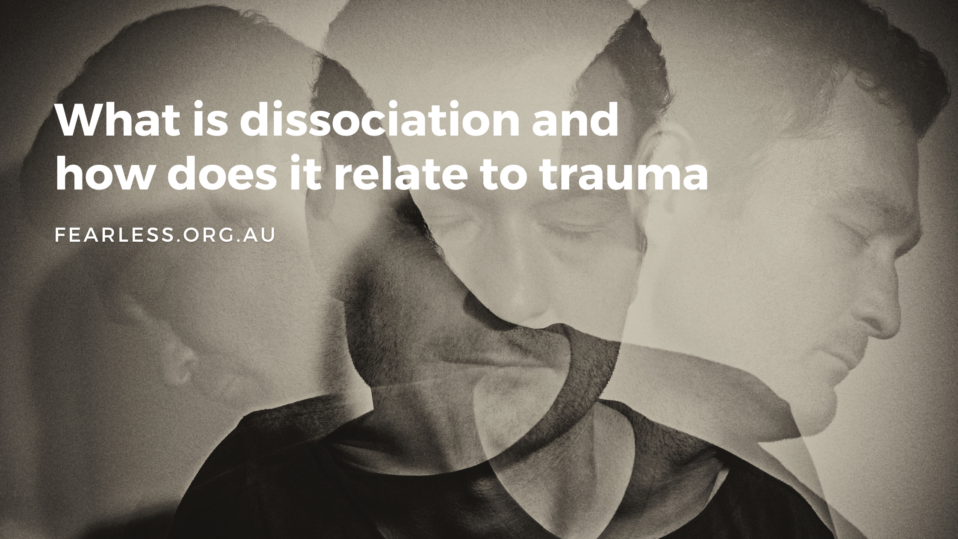
Have you ever driven somewhere familiar and arrived without any memory of the journey? Or been in a conversation and suddenly realised you have no idea what was just said, as though you were somewhere else entirely?
These are mild, everyday examples of dissociation. Most people experience them occasionally and they are entirely normal.
For people living with trauma and post traumatic stress, dissociation can go further than this. It can become a significant and sometimes frightening part of daily life. And because it is not well understood or widely talked about, many people do not have a name for what they are experiencing.
FearLess is a charity supporting people living with post traumatic stress in Australia and New Zealand. This article is a general awareness resource and is not medical advice.
What is dissociation?
Dissociation is a broad term for experiences of disconnection from thoughts, feelings, body sensations, surroundings, or identity. It exists on a spectrum.
At the milder end, dissociation looks like daydreaming, spacing out, or going through the motions of a task without conscious engagement. Most people experience this regularly.
At the more significant end, dissociation can involve feeling detached from the body, as though watching oneself from a distance. Feeling that the world around you is unreal or dreamlike. Gaps in memory for periods of time. Feeling like a different version of oneself. These experiences can be unsettling, particularly when they occur without warning.
Why dissociation happens in trauma
Dissociation is understood to be a protective mechanism. During an overwhelming traumatic experience, the mind can disconnect from what is happening as a way of limiting the impact of the experience. This is the nervous system doing what it can to protect the person.
The problem, as with many trauma responses, is that this mechanism can persist long after the original trauma has passed. Certain triggers, whether sensory, emotional, or situational, can activate the same disconnection as a reflexive response.
For more on how trauma affects the nervous system, see fearless.org.au/nervous-system-regulation-trauma.
Dissociation and PTSD
Dissociation is recognised as a symptom of PTSD, and some people experience what is described as a dissociative subtype, where detachment and emotional numbing are particularly prominent features.
For people living with complex PTSD, dissociation can be a more frequent and more disruptive part of life, often linked to the sustained nature of the trauma that produced it. For more on complex PTSD, see fearless.org.au/what-is-complex-ptsd.
What can help during dissociation
Grounding techniques are widely recommended as a practical tool during episodes of dissociation. The goal of grounding is to bring attention back to the present moment and to the body.
This might involve noticing five things you can see in the room. Pressing your feet firmly into the floor. Holding something cold or textured. Saying your own name, the date, and where you are.
These techniques work by activating sensory awareness and helping the nervous system recognise that the present environment is safe. FearLess has more on grounding techniques at fearless.org.au/2026/02/09/grounding-techniques-for-ptsd and fearless.org.au/2023/02/06/grounding-techniques-understanding-and-practicing.
When to seek support
If dissociation is occurring frequently, lasting for extended periods, significantly affecting daily functioning, or causing distress, it is important to speak with a GP or mental health professional. Regular dissociation is something that can be addressed with appropriate therapeutic support.
A GP is a good starting point. They can assist with a referral to a practitioner with experience in trauma-related presentations.
FearLess has resources on treatment options at fearless.org.au/2025/11/02/ptsd-treatment-options-australia and on healing strategies at fearless.org.au/healing-strategies.
Support:
- Lifeline: 13 11 14
- Beyond Blue: 1300 22 4636
- SANE Australia: sane.org
- healthdirect: healthdirect.gov.au
FearLess is a charity, not a medical organisation. This content is for general awareness only and does not constitute professional advice. Please speak with a qualified healthcare provider about your individual circumstances.

Post a comment