
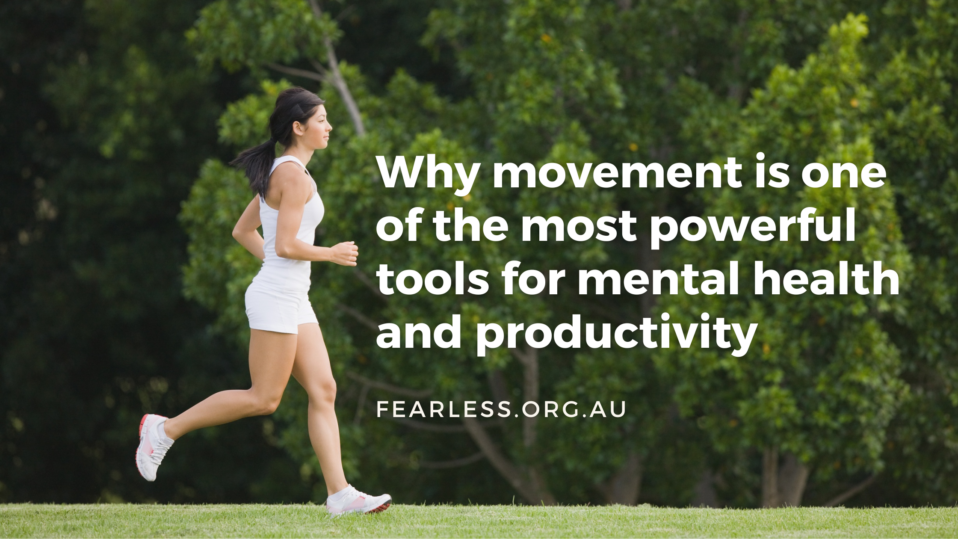
The relationship between physical movement and mental health is one of the most well-supported findings in psychological and neuroscientific research. And yet, in a world that rewards sitting still and pushing through, it remains one of the most underused tools available to us.
FearLess is a charity working with people living with post traumatic stress in Australia and New Zealand. This article explores the science of movement and mental health, why productivity depends on the brain’s biology rather than sheer effort, and how movement can play a meaningful role in day-to-day wellbeing and trauma recovery.
This is a general awareness resource and is not a substitute for professional medical advice. Please speak with a qualified healthcare professional about your individual circumstances.
The brain is living biology, not a machine
Modern work culture tends to treat the brain like a computer. Input goes in, output comes out, and if the output is not good enough, the solution is simply to try harder or work longer.
But the brain does not work that way. It is living tissue. It needs oxygen, nutrients, rest, and movement to function well. When those needs are not met, cognitive function declines, regardless of how much effort is applied.
Research published in journals including the British Journal of Sports Medicine and Neuroscience and Biobehavioural Reviews has consistently found that physical activity improves attention, memory, executive function, and creative thinking. These are not small improvements. In some studies, participants who exercised before cognitive tasks outperformed those who did not by significant margins.
The reason comes down to what movement does to the brain at a physiological level.
What happens in the brain when you move
When the body moves, blood flow to the brain increases significantly. This delivers more oxygen and glucose, the brain’s primary fuel sources, to the regions responsible for thinking, planning, and emotional regulation.
Movement also triggers the release of a range of neurochemicals that support mental health and cognitive performance.
Endorphins are the most well known, associated with the sense of wellbeing many people feel after exercise. But movement also increases brain-derived neurotrophic factor, sometimes called BDNF, which supports the growth and maintenance of brain cells and is associated with improved learning, memory, and mood.
Serotonin and dopamine, two neurotransmitters strongly linked to mood regulation and motivation, are both supported by regular physical activity. Many antidepressant medications work by targeting these same systems. Movement is not medication, but the overlap is not coincidental.
Cortisol, the primary stress hormone, is also reduced by moderate exercise over time. For people whose nervous systems are chronically activated by stress or trauma, this reduction is particularly significant.
For more on how trauma affects the brain and nervous system, see Understanding your nervous system and trauma.
Why a short walk can do what hours at a desk cannot
There is a specific reason that walking, in particular, has such a reliable effect on creative thinking and problem-solving.
When the brain is in focused, effortful mode, it is engaging the prefrontal cortex heavily. This is useful for analytical tasks but can create a kind of tunnel vision that makes it difficult to see beyond the immediate problem.
Walking activates what researchers call the default mode network, the brain state associated with mind-wandering, daydreaming, and the making of unexpected connections. This is the mode in which insight tends to arrive. Not when we are forcing it, but when we have stepped back enough to let it emerge.
A study from Stanford University found that walking increased creative output by an average of 81 percent compared to sitting. The effect persisted even when participants walked on a treadmill facing a blank wall, suggesting it is the movement itself rather than the visual environment that produces the benefit.
For people who spend long hours at desks, or who find their thinking becomes circular and unproductive under pressure, this finding has direct practical implications.
Movement and mental health: the broader picture
Beyond productivity, the relationship between movement and mental health is one that deserves broader attention in Australia and New Zealand.
The Australian Physical Activity and Sedentary Behaviour Guidelines recommend that adults engage in 150 to 300 minutes of moderate physical activity per week. Yet surveys consistently find that a significant proportion of Australians do not meet these guidelines, with mental health challenges such as depression, anxiety, and trauma-related conditions often cited as barriers to movement.
This creates a difficult cycle. Poor mental health makes movement harder. And the absence of movement makes mental health harder to maintain.
Research published in The Lancet Psychiatry found that people who exercised regularly reported 43 percent fewer days of poor mental health per month compared to those who did not exercise. The study, which drew on data from over 1.2 million Americans, found that team sports, cycling, and aerobics had the strongest associations with mental health benefits, though all forms of activity showed positive results.
The Black Dog Institute has resources on exercise and mental health at blackdoginstitute.org.au. Beyond Blue also provides guidance on physical activity and wellbeing at beyondblue.org.au.
Movement and PTSD recovery
For people living with post traumatic stress, movement carries additional significance.
PTSD is, in part, a condition of the body. Trauma is stored in the nervous system, in patterns of tension, hypervigilance, and physiological arousal that persist long after the original event. Approaches that engage the body directly, rather than working solely through cognitive or verbal means, are increasingly recognised as valuable parts of a comprehensive recovery approach.
Research into trauma-informed yoga is particularly compelling. Studies have found that regular yoga practice can reduce PTSD symptoms, improve emotional regulation, and support a sense of safety and connection with the body. Trauma-informed yoga is designed to be gentle, choice-based, and attentive to the specific needs of people who have experienced trauma.
FearLess has written about yoga and the brain at How yoga affects the brain and PTSD recovery.
Walking and other forms of rhythmic movement, where the left and right sides of the body alternate in a regular pattern, are also associated with nervous system regulation. This bilateral stimulation is the same principle that underlies EMDR therapy, one of the most evidence-based treatments for PTSD.
For more on PTSD treatment options in Australia, including movement-based approaches, see PTSD treatment options in Australia.
The Phoenix Australia Centre for Posttraumatic Mental Health provides evidence-based guidance on PTSD recovery approaches at phoenixaustralia.org.
What counts as movement
One of the most important things to understand about movement and mental health is that it does not require intensity or duration to be beneficial.
Any movement that feels accessible, sustainable, and appropriate for a person’s current physical and mental state counts. This might include a ten minute walk around the block. Gentle stretching in the morning. Swimming or cycling. Dancing in the kitchen. Gardening. Playing with children or pets. A yoga class. A community sport.
The most beneficial movement is the movement that actually happens. Starting small is always better than waiting until the conditions feel right to start big.
For people living with PTSD or other mental health challenges, movement that is body-aware and self-paced is often the most appropriate starting point. Pushing through physical discomfort or forcing intensity can activate rather than settle the nervous system. The goal is regulation, not performance.
FearLess has more on healing strategies, including movement, at fearless.org.au/healing-strategies.
Practical ways to bring more movement into your day
For anyone who spends significant time at a desk, or who finds their mental health is affected by long periods of sedentary activity, the following approaches are worth considering.
Take a walking break when focus fades rather than pushing through. Even ten minutes outside can reset cognitive function and improve mood for the remainder of the day.
Build movement into transitions rather than trying to find dedicated exercise time. Walk to a meeting rather than driving. Take stairs. Step outside before starting work and after finishing.
If sitting for long periods is unavoidable, short movement snacks throughout the day, two to three minutes of walking or stretching every hour, have been shown to offset some of the cognitive and mood effects of prolonged sitting.
For people navigating trauma or high stress, starting with gentle, outdoor movement is often more beneficial than high-intensity exercise, which can elevate cortisol rather than reduce it.
A note on barriers
FearLess acknowledges that movement is not equally accessible to everyone. Physical injury or chronic pain, financial barriers to gym or class fees, geographic isolation, fatigue from PTSD or depression, and the absence of safe outdoor spaces can all make movement harder to access.
The goal is not to add pressure to an already heavy load. It is to recognise that even small amounts of gentle movement, taken at whatever pace is possible, have real benefits. And that those benefits are available to everyone, not just those with the time, energy, or resources for structured exercise.
If you are struggling to find a starting point, speaking with a GP is worthwhile. They can assist with referrals to exercise physiology services, which are sometimes available through Medicare for people with chronic conditions including mental health diagnoses.
In summary
The brain is not a machine. It is living biology that responds to movement, rest, oxygen, and care.
Productivity is not about pushing harder. It is about working with the brain’s actual needs rather than against them. And mental health is not separate from physical health. The two are deeply, meaningfully connected.
For people living with post traumatic stress, movement offers something beyond fitness. It offers a way back into the body, a means of regulating the nervous system, and a genuinely evidence-based complement to professional care.
Start where you are. Move in whatever way feels possible today. And know that even the smallest steps count.
Further support
- Lifeline: 13 11 14
- Beyond Blue: 1300 22 4636
- Black Dog Institute: blackdoginstitute.org.au
- Phoenix Australia: phoenixaustralia.org
- Head to Health: headtohealth.gov.au
FearLess is a charity, not a medical organisation. This content is for general awareness only and does not constitute professional advice. Please speak with a qualified healthcare provider about your individual circumstances.

Post a comment